

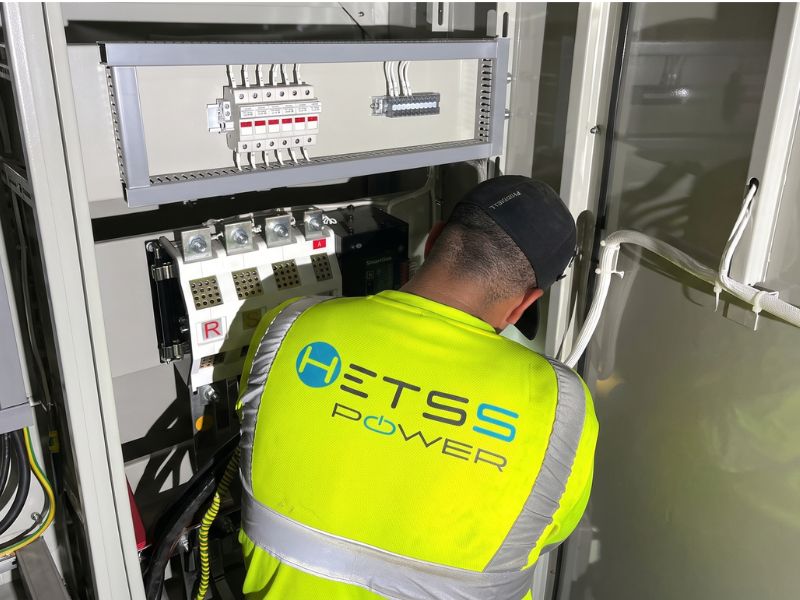

The most expensive way to save money on an electrical installation is hiring someone who cannot file the paperwork.
Ask around on this island and you will hear a version of the same claim: “Any electrician can do the work. At the end you bring in a certified guy, he signs it off, DTI comes, done.”
That is not the system. It has never been the system, and the law says so in plain language.
At HETSS we get called in when that assumption has already collapsed — usually with finished walls in the way. Therefore it is worth understanding what the rules actually say, because they are shorter and clearer than most people expect.
What the Law Says About Who May Do the Work
The Landsbesluit installatievoorschriften elektrische inrichtingen (AB 1996 GT 5), made under the Landsverordening elektriciteitsconcessies, governs electrical installations in Aruba. Article 19 opens with a sentence that leaves no room for interpretation: only an installer whom the authorities have formally recognized and entered in the official register may install, extend, or modify an electrical installation.
Moreover, that recognition is not a lifetime title. The certificate carries a validity of one calendar year, and the installer must renew it.
Note what the law regulates. Not the inspection. Not the signature. The work itself, from the first conduit in the slab.
What Article 20 Requires Before Work Begins
The sequence is written down. Under Article 20, before anyone may begin installation or modification work, the installer files the application card — in triplicate — through the utility, which marks the connection point, the location of the metering equipment, and the phase the installation will connect to. That file reaches the Head of DTI within 48 hours and comes back stamped.
For anything beyond a very small installation, the decree also requires an installation drawing: a schematic showing current distribution, protective device ratings, conductor cross-sections and group numbering, plus a scaled floor plan identifying conduit routing, equipment, and the use of each space. Damp rooms, corrosive environments, and fire- or explosion-risk areas all need specific identification.
Article 20 then adds the clause that quietly ends the improvisation culture: no deviation from the approved plans without permission.
At the end, Article 21 requires an as-built revision drawing in duplicate. The inspection itself verifies not only compliance with the rules but also insulation resistance by measurement, and whether the crew actually built the installation the way the authorities approved it.
What You Are Really Asking a Certified Electrician to Sign
So when an uncertified contractor tells you he will “bring in a certified electrician at the end to sign,” understand precisely what he is proposing. He wants a licensed professional to put his registration — which Article 19 allows the authorities to strip for repeated violations — behind work he never designed, never filed, never watched go into the walls, and for which the law will hold him responsible for a full year after commissioning.
Serious certified electricians decline that. Consequently, the ones who accept it are the reason the file eventually lands on an inspector’s desk looking like a puzzle with pieces missing.
Where NEN 1010 Knowledge Actually Shows Up
Article 1 of the Landsbesluit requires installations to comply with the specific provisions of the decree and with NEN 1010. This is not optional, and it is not interchangeable with American practice. The decree permits an installation built to the National Electrical Code (ANSI/NFPA 70) only where the installer has filed a written, reasoned exemption request with the Head of DTI and the Head has granted it, with conditions attached.
Many uncertified electricians on this island are not proficient in NEN 1010. They are proficient in what they have seen other people do. Those are not the same body of knowledge, and the gap shows up in exactly the details an inspector is trained to find: voltage drop limits — the decree caps them at 2% for lighting and 5% for other purposes, measured from the metering equipment — conductor sizing, circuit segregation, earthing arrangements, protection coordination, and insulation resistance.
We have been called into homes where the correction meant cutting open finished walls and ceilings, after paint, after tile, after cabinetry, because conductors were undersized, circuits shared what they should never have shared, or the installation simply did not resemble anything anyone could document. There is no cheap version of that repair. You pay for the electrical work twice and for the finishes twice, and you still have to pass the re-inspection that Article 21 provides for.
Why a Failed Inspection Is Also a Safety Problem
Beneath all of it sits the thing that never appears on any quotation: an installation that fails inspection is an installation that was going to fail in service.
Undersized conductors run hot inside your ceiling. Bad terminations arc. Missing protection does nothing on the day it is needed. Furthermore, Aruba’s climate — salt, humidity, heat — is unforgiving of shortcuts that might survive elsewhere.
The inspection is not bureaucracy. It is the last line of defense between your family, your guests, your staff, and a fire that starts behind a wall at three in the morning.
How to Verify a Certified Electrician in Ten Minutes
You do not need technical knowledge to avoid all of this. You need to ask three questions before you sign anything.
1. Ask to see the card. Every DTI-certified electrician holds a DTI certification card. Ask for it. Photograph it. A certified electrician will produce it without hesitation, and the reaction to the question tells you most of what you need to know.
2. Verify the name against the official list. You can request the list of certified electricians and electrical contractors from DTI or from Elmar. Elmar also publishes it on Elmar’s inspection page. A name that isn’t on the list is not a matter of opinion.
3. Put it in the contract. If your general contractor includes electrical work in his scope, write into the contract that a DTI-certified electrical contractor will execute the installation and that the design will follow NEN 1010.
If the price you were given drops the moment you insist on all three, you have just discovered what that price was actually based on.
There Is a Fourth Question, and It Costs the Most
The three above protect you technically. However, there is a fourth one that decides your schedule: when does the service request go to Elmar?
That single date determines whether your building energises on handover or sits finished and dark for well over a year. Only a DTI-certified contractor can file it, and filing at design stage rather than at completion is the difference between a project that opens on time and one that waits.
If you are planning a build, ask your contractor to show you the filed application before you sign anything.
Get the Electrical Right From the Start
At HETSS we carry three DTI-certified electricians on our team, and we design to NEN 1010:2015 in a form an inspector can follow.
Whether it is a new build, an expansion, or an upgrade, we handle the electrical installation and the DTI submission as one process, not two.
📞 Call or WhatsApp us at +297 737-0700 ✉️ or contact us.