


Why a finished building can sit in the dark for two years, and how the filing date decides everything.
There is a moment that repeats itself on this island with almost mechanical regularity.
The house is finished. The tile is laid, the kitchen is in, the paint has cured, the furniture is on a container somewhere between Miami and Barcadera. The owner has a mortgage running, or a rental calendar already taking bookings, or a lease signed with a tenant who wants to open in six weeks.
And there is no power.
Nothing is broken. However, the Elmar service request went straight into a queue that nobody in the project ever planned for. At HETSS we get the call at exactly this point. It is the worst possible moment to be receiving it, and it is almost always avoidable.
The Queue Is Not a Delay. It Is the Process.
Most complaints we receive about “impossible delays at Elmar” are not, on investigation, arbitrary delays. Instead, they are a queue — long, sequential, entirely predictable — that the project entered far too late.
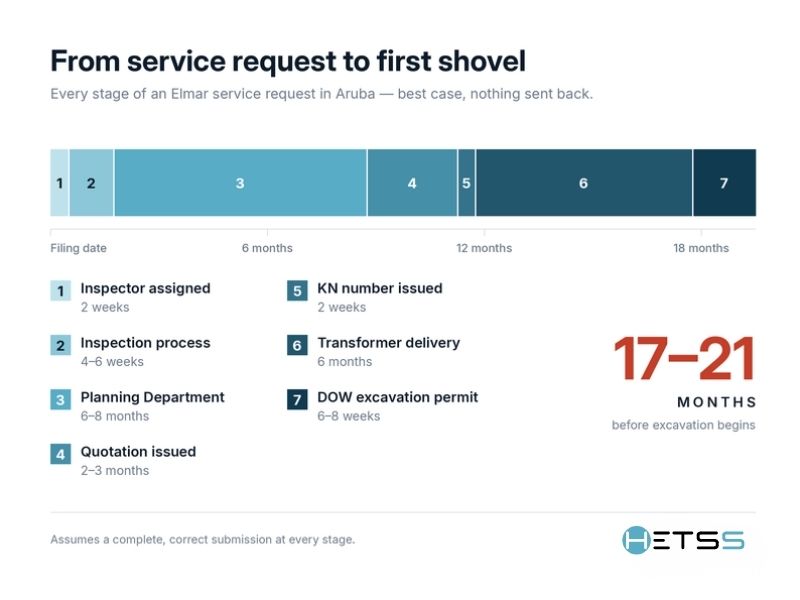
Assume the best case. Your Elmar service request reaches the portal with every required document complete. Nothing is missing, nothing gets bounced back, nobody has to chase you. The clock now starts:
| # | Stage | Duration | Running total |
|---|---|---|---|
| 1 | Completed SR is assigned to an inspector in Elmar’s Inspections Department | 2 weeks | ~0.5 months |
| 2 | Assigned inspector begins the inspection process | 4–6 weeks | ~1.5–2 months |
| 3 | Load is 18 kVA or above — file transfers to the Planning Department, which begins processing | 6–8 months | ~7.5–10 months |
| 4 | Planning determines a transformer and/or underground cable route is required; quotation letter issued | 2–3 months | ~9.5–13 months |
| 5 | You pay. File returns to Inspections, SR is completed, KN number issued | 2 weeks | ~10–13.5 months |
| 6 | Transformer and high-voltage switching components ordered and delivered | 6 months | ~16–19.5 months |
| 7 | DOW excavation permit obtained | 6–8 weeks | 17–21 months |
| Total, before a single shovel enters the ground | 17 to 21 months |
Read the last line again. A year and a half to nearly two years — and that is the timeline before excavation can even begin, not the timeline to energisation. It assumes a complete, correct submission at every stage. One incomplete document, one revision, one round of back-and-forth, and you add to it.
The Lighter Version Is Still a Full Year
However, the lighter version is not much lighter. Where Planning determines that a low-voltage cabinet (laagspanningskast) will do rather than a transformer, the sequence runs roughly six months for Planning to reach and communicate that conclusion, two months for the invoice, and another two months at DOW.
With the intake and closing steps on either end, that still lands at about twelve months. A full year.
The Only Question That Matters: When Did the Clock Start?
If you engage a DTI-certified electrical contractor at design stage, his team produces engineered plans and uploads the Elmar service request while the site is still being cleared. Those seventeen to twenty-one months then run in parallel with your foundations, structure, roof, block work, plaster, tile, kitchen, and finishes.
In other words, Elmar’s Planning Department and your general contractor work the same calendar. Somewhere around handover the KN number lands, the trench gets its permit, and the building energises roughly when it was always meant to.
If an uncertified crew priced the electrical scope, nobody had the authority to file anything, and no engineered drawings existed to file. Therefore the request goes up after the building is finished. The seventeen-to-twenty-one-month clock starts on the day you thought you were done.
In short, that is the whole story. Same project, same load, same utility. The rules don’t change. Neither do the fees. Consequently, the only variable is the date on the submission, and it decides whether your building sits empty for two years or opens on schedule.
What Filing Late Actually Costs
Now count the mortgage payments on an empty building for eighteen months. Add two missed high seasons on a rental. Then count the tenant who signed a lease and walked away, the crew you have to remobilise, the furniture in storage, the interest running on capital that is producing nothing, and the transformer invoice that was never in the budget.
Set all of that against the few thousand florin saved on the electrical quotation. Nobody does this arithmetic until it is far too late to help them.
How to Protect Your Schedule
Therefore, ask your general contractor one question, and ask it before you sign: has the Elmar service request been filed, and can you see it?
That single piece of paper is your proof that you are not starting a seventeen-month clock on the day your building is finished. It also tells you something else — only a DTI-certified contractor is legally able to file it in the first place, which is a separate subject we covered here.
We File While the Foundations Are Going In
At HETSS we work the other way around from the island norm. Our drafting department turns engineered electrical plans around quickly — deliberately — so that the Elmar service request goes onto the portal at the beginning of the project.
That is not a courtesy. It is the whole engineering strategy. It moves the transformer question, the laagspanningskast question, and the infrastructure cost question to the front of the schedule, where they become budget line items you can plan around, instead of the back, where they become emergencies.
Whether it is a new build, an expansion, or an upgrade, the earlier we look at it, the more of that timeline you get to keep.
📞 Call or WhatsApp us at +297 737-0700 ✉️ or contact us.